
Top 10 Wooden Puzzle Manufacturers for Global Buyers

Wooden Puzzle has moved beyond a traditional children’s toy. It now serves families, educators, collectors, gift retailers, and adult hobbyists. Natural wood, tactile pieces, and screen-free play remain strong selling points. However, buyers should examine more than attractive product photography.

Grand View Research estimates the global puzzles market reached approximately USD 6.98 billion in 2023. Its 2024–2030 analysis also indicates continued market expansion. Fortune Business Insights values the global toy market at about USD 108.7 billion in 2023. These figures suggest meaningful opportunities for dependable wooden puzzle suppliers. Yet market reports are not perfectly aligned. Definitions, regions, and research methods differ. Buyers should treat forecasts as useful signals, not guaranteed results.

This guide reviews ten Wooden Puzzle manufacturers for global buyers. The evaluation considers material quality, design capability, production consistency, safety documentation, customization, packaging, and export experience. It also considers practical details, such as smooth edges, accurate cuts, odor control, and clear assembly instructions. Reputable manufacturers should provide evidence supporting their claims. Relevant benchmarks may include ASTM F963, EN 71, ISO 8124, and FSC certification, where applicable. Certification alone is not enough. Factory communication and sample inspection still matter. A beautifully finished sample can hide inconsistent mass production. That risk deserves attention. No ranking is flawless, and supplier suitability depends on order volume, target age, market standards, and budget. The following selection aims to provide a reliable starting point for informed sourcing decisions.
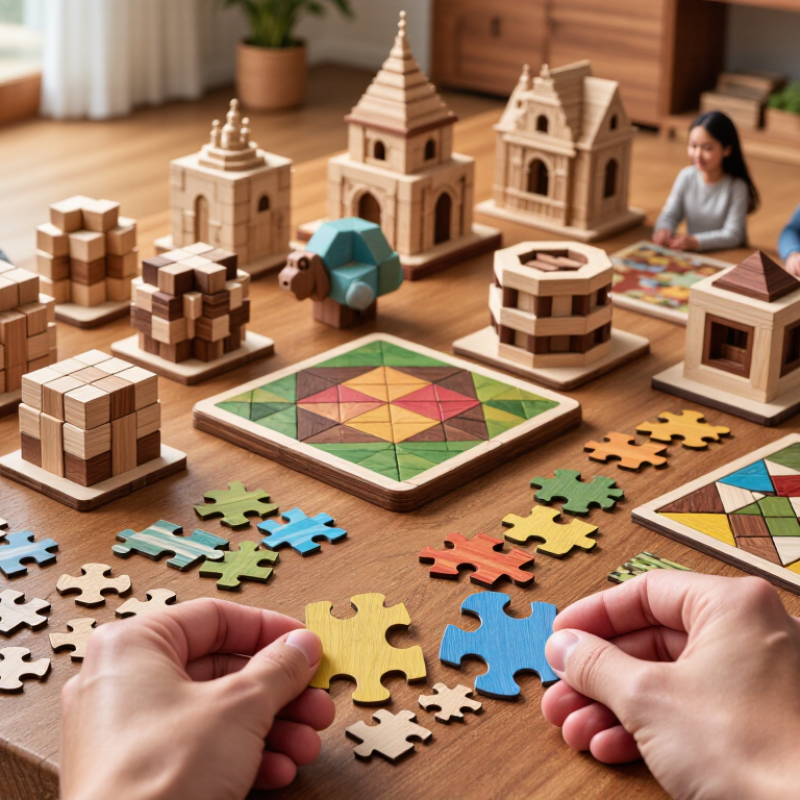
Top 10 Wooden Puzzle Manufacturers for Global Buyers

What Defines a Leading Wooden Puzzle Manufacturer

A leading wooden puzzle manufacturer is defined by measurable discipline, not attractive product photos. Buyers should inspect wood sourcing, cutting accuracy, coating safety, and batch consistency. A puzzle should fit smoothly, without sharp edges, strong odors, or loose paint.

ASTM F963-23 requires comprehensive toy safety testing, including materials, mechanical hazards, and surface coatings. A serious manufacturer should provide current test records, traceable samples, and clear corrective-action procedures. FSC’s 2023 market figures reported more than 160 million hectares of certified forest worldwide. Responsible sourcing therefore needs documented chain-of-custody evidence, not vague sustainability claims. It is a practical buying signal.

Production experience also matters. Skilled factories control moisture before cutting, because unstable wood can warp during shipping. They test interlocking strength, print clarity, color durability, and packaging compression.

A sample may look perfect. Mass production can still expose weak controls.

Circana reported an 8% decline in the U.S. toy market in 2023. That pressure makes durability and repeat value more important for global buyers. Reliable manufacturers should offer inspection checkpoints, defect-rate records, multilingual compliance files, and realistic lead times. Custom artwork is useful, but engineering accuracy matters more. Some suppliers still overpromise delivery, especially during peak seasons. Buyers should request a pilot batch before placing large orders. This step costs time, yet it reveals problems early.

How the Top 10 Manufacturers Were Selected

Selecting the top ten wooden puzzle manufacturers required more than searching online directories. We reviewed production history, workshop evidence, product catalogs, and export records where available. Each candidate had to show consistent woodworking processes and clear quality-control responsibilities. We looked for kiln-dried wood, smooth edges, accurate cutting, and secure paint adhesion. Small details mattered, including clean tray corners and pieces that fit without force. These checks reflect real buying concerns, not attractive photographs. Photos are not proof.

Safety documentation formed another important filter. We examined test reports, material declarations, age grading, and packaging information for relevant markets. Manufacturers with traceable material sources received stronger consideration. Capacity was assessed through stated monthly output, sample consistency, lead-time records, and communication during inquiries. We also compared prototype support, mold ownership terms, defect handling, and replacement policies. Transparent quotations helped separate dependable suppliers from low-cost, high-risk offers. Price alone was never enough.

Reliability was judged across the whole purchasing experience. Response speed, technical answers, shipment coordination, and willingness to correct samples all influenced the final list. We gave more weight to repeatable evidence than polished sales language. Still, the process has limits. Public records can be incomplete, and factory visits are not always possible. Some capable workshops may be missed because their documentation is modest. That weakness deserves attention. Therefore, the selection should guide due diligence, not replace it.

Profiles of the Top 10 Wooden Puzzle Manufacturers

The ten profiles highlight different strengths in wooden puzzle manufacturing. One focuses on precision-cut educational puzzles, while another specializes in large-format family designs. Several combine CNC cutting with hand sanding, creating clean edges and a warmer tactile finish. Their workshops typically use birch, beech, or rubberwood, depending on cost, durability, and availability.

Strong manufacturers explain their wood sourcing, adhesive choices, paint safety, and quality controls. They should provide production samples, carton details, and realistic lead times. Experienced buyers also inspect piece thickness, image alignment, and fit consistency. These small checks often reveal more than polished catalogs. A few manufacturers disclose less than buyers expect. That weakness should not be ignored.

Tips: Request a sample from each shortlisted supplier. Test the puzzle for sharp corners, loose pieces, odor, and color transfer. Ask for batch inspection photos before shipment. Confirm packaging strength with a simple drop-test video. Check whether the factory can maintain the same finish across repeat orders. Do not rely on certificates alone; verify their validity and scope. A reliable supplier answers clearly, though occasional production mistakes can still happen. Build a correction process before placing a large order.

Top 10 Wooden Puzzle Manufacturers for Global Buyers - Profiles of the Top 10 Wooden Puzzle Manufacturers

Anonymous manufacturer profiles are provided for comparison. Buyers should verify current certifications, production capacity, testing documents, lead times, and export records directly before placing an order.
Rank Anonymous Profile Primary Manufacturing Region Main Product Focus Typical Materials Customization Capability Common Compliance Requirements Best Fit for Global Buyers
01 Manufacturer Profile A East Asia Mass-market wooden jigsaw puzzles and educational sets Plywood, MDF, paperboard packaging, water-based coatings Custom artwork, piece counts, packaging, inserts, and private-label production Product safety testing, heavy-metal limits, packaging and labeling rules Retail chains, distributors, online marketplaces, and promotional programs
02 Manufacturer Profile B Central Europe Premium wooden puzzles and artistic gift products Hardwood, birch plywood, recycled paper, soy- or water-based inks Limited-edition artwork, shaped pieces, premium boxes, and gift sets Wood-origin documentation, chemical safety, packaging recycling requirements Museum shops, specialty retailers, design stores, and premium gifting
03 Manufacturer Profile C Southeast Asia Children’s wooden puzzles and early-learning products Rubberwood, plywood, non-toxic paints, paperboard cartons Age grading, educational themes, colors, shapes, and multilingual packaging Toy safety testing, small-parts controls, coatings safety, and traceability Preschools, educational distributors, children’s retailers, and gift shops
04 Manufacturer Profile D North America Small-batch wooden puzzles and personalized products Maple, birch, walnut, laser-safe plywood, recycled packaging Names, dates, maps, photographs, custom silhouettes, and short runs Consumer product safety, labeling, packaging, and material disclosures E-commerce sellers, corporate gifts, local retailers, and custom orders
05 Manufacturer Profile E South Asia Handcrafted wooden puzzles and artisan giftware Mango wood, rubberwood, acacia, plywood, natural finishes Hand-carved details, regional motifs, assorted finishes, and gift packaging Timber legality, finish safety, quality inspection, and export documentation Fair-trade retailers, boutique stores, cultural gift programs, and wholesalers
06 Manufacturer Profile F Eastern Europe Traditional wooden puzzles, brain teasers, and mechanical designs Beech, birch, pine, plywood, and natural oil or wax finishes Mechanical concepts, branded packaging, instructions, and gift collections Toy safety, surface-finish safety, timber traceability, and carton labeling Specialty toy stores, puzzle distributors, museums, and hobby retailers
07 Manufacturer Profile G Southern Europe Decorative wooden puzzles and destination-themed collections Poplar plywood, beech, printed paper, cardboard, and matte coatings Regional artwork, tourist themes, multilingual copy, and seasonal assortments Consumer safety, ink and coating controls, origin labeling, and packaging rules Tourist retailers, bookstores, cultural institutions, and souvenir distributors
08 Manufacturer Profile H East Asia Large-format puzzles, promotional items, and contract manufacturing MDF, plywood, laminated paper, corrugated board, and protective coatings Complex shapes, printed artwork, display-ready cartons, and bulk programs Factory quality systems, product testing, packaging compliance, and inspection reports Marketing agencies, corporate buyers, event programs, and high-volume importers
09 Manufacturer Profile I Oceania Nature-themed wooden puzzles and environmentally focused products Certified or documented timber, plywood, recycled paper, low-VOC finishes Wildlife artwork, sustainability messaging, educational inserts, and gift boxes Sustainable sourcing evidence, product safety, recycling claims, and labeling Eco-conscious retailers, visitor centers, educational programs, and gift buyers
10 Manufacturer Profile J Latin America Regional artwork, family puzzles, and handcrafted educational games Fast-growing hardwoods, plywood, MDF, natural dyes, and paper packaging Local illustrations, bilingual packaging, custom shapes, and curated collections Timber-origin records, toy safety, finish safety, packaging, and export documentation Regional distributors, cultural stores, educational buyers, and specialty importers

Comparing Products, Customization, and Production Capabilities

When global buyers compare ten wooden puzzle manufacturers, product quality is only one part of the decision. I examine wood sourcing, panel density, cutting accuracy, print adhesion, and final sanding. A well-made puzzle should feel smooth, not merely look attractive. Pieces need clean edges and enough friction to stay connected. Samples reveal more than polished catalogs. Request the same artwork from several factories, then compare color, fit, packaging, and damage after shipping. Small differences matter.

Customization often determines whether a supplier can support a serious retail program. Ask about custom shapes, piece counts, difficulty levels, box structures, inserts, and instruction languages. Experienced manufacturers should explain dielines, proofing, sampling, and tooling costs clearly. They should also identify which changes affect lead time. Some suppliers promise everything. That deserves careful questioning. A factory may offer many options but lack stable control during production. Review a pre-production sample, approve measurable standards, and confirm how rejected pieces are handled. I prefer written tolerances, though they can feel overly technical.

Production capability should be judged beyond monthly capacity claims. Check cutting equipment, dust control, color management, inspection procedures, and batch traceability. Ask whether quality checks occur after cutting, printing, assembly, and packing. Reliable communication matters when a shipment contains thousands of small pieces. A capable team reports defects early, even when the news is inconvenient. Still, no process is perfect. Humidity can change wood slightly, and packaging may need another test. Buyers should compare factory records, sample results, certifications, and realistic delivery schedules before choosing a long-term manufacturing partner.

Key Buying Factors for Global Buyers

Top 10 Wooden Puzzle Manufacturers for Global Buyers

Global buyers should evaluate more than price when selecting wooden puzzle manufacturers. Material safety, production consistency, and export experience matter equally. Circana reported a 1% decline in global toy sales in 2023, increasing pressure on purchasing teams to reduce waste and returns. A reliable manufacturer should provide material specifications, batch records, and clear quality-control procedures.

Check whether the factory uses responsibly sourced wood, such as FSC-certified timber, and ask for current documentation. Paints, coatings, and adhesives should meet the destination market’s requirements. ASTM F963 applies in the United States, while EN 71 is widely used across Europe. Request third-party test reports, not only internal claims. Sample the finished puzzle carefully. Check edge smoothness, piece fit, color consistency, packaging strength, and odor. Small defects can become expensive complaints.

Tips: Confirm minimum order quantities, lead times, carton dimensions, and replacement policies before signing. Ask for a pilot order. It reveals more than a polished factory tour. Also compare packaging volume, because freight cost often depends on cubic space. ISO 2859-based sampling can support a more objective inspection plan. No checklist is perfect. I would still inspect random cartons before shipment, especially when artwork or materials change. Grand View Research estimates the global toys market will continue growing through 2030, but growth does not excuse weak supplier controls.

Article Source: