
How to Source Vinyl Swing Sets for Global Buyers?
Sourcing vinyl swing sets for global buyers requires more than comparing catalog prices. It demands practical knowledge of materials, manufacturing controls, child safety, and international logistics. Vinyl may resist moisture and fading, but its performance depends on formulation, thickness, UV stabilizers, and assembly quality. Ask suppliers for material specifications, safety test reports, production photos, and traceable batch records. Do not rely on polished product images alone.
Details matter. A reliable supplier should explain load limits, anchor systems, swing spacing, edge finishing, and packaging protection. Check whether the swing set is designed for residential use, commercial playgrounds, or both. These categories can involve different testing expectations and installation requirements. Confirm the relevant destination-market standards before placing an order, because requirements vary across regions. A third-party inspection can verify dimensions, hardware, surface quality, carton labels, and random product performance before shipment.
The supply chain is rarely perfect. A sample may look excellent while mass production reveals color variation or weaker hardware. That risk deserves attention. Compare several suppliers, request a production sample, and record every agreed specification in the purchase contract. Clarify warranty coverage, replacement parts, lead times, spare hardware, and responsibility for shipping damage. Experienced buyers also review export documents, packaging dimensions, customs information, and installation instructions in the buyer’s language. Small omissions can create expensive delays.
For global buyers, the strongest sourcing decision balances safety, durability, price, and dependable communication. Vinyl swing sets should be evaluated as complete systems, not attractive outdoor products. A careful process protects children, retailers, and long-term brand credibility. Mistakes still happen. Good sourcing plans make them easier to detect and correct.

Define Vinyl Swing Sets and Their Global Market Requirements
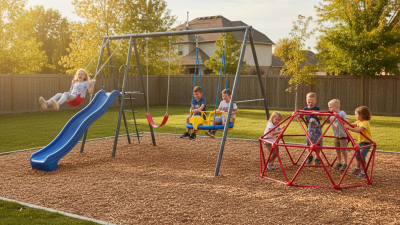
Vinyl swing sets are outdoor play systems built around swings, slides, and climbing elements. Their posts may use vinyl-coated wood, PVC sleeves, or weather-resistant composite materials. Vinyl improves moisture resistance and reduces painting needs. It does not automatically guarantee safety.
Grand View Research estimates the global playground equipment market reached about USD 5.2 billion in 2023. IMARC reports a different market boundary and estimates approximately USD 5.1 billion that year. These figures differ because some reports include commercial parks, fitness equipment, or installation services. Buyers should treat forecasts as directional, not exact.
Global sourcing requires more than attractive colors and low pricing. Suppliers should provide material specifications, UV-resistance evidence, load testing, installation drawings, and replacement-part information. ASTM F1487 is widely referenced in North America, while EN 1176 guides many European projects. Importers must confirm the destination market’s applicable rules. Check fasteners, pinch points, fall zones, platform heights, and impact-absorbing surfaces. Small details matter.
Vinyl can crack in severe cold. It can also fade under intense sunlight. Ask for climate-specific testing.
A reliable factory should explain its test methods, production controls, and limitations clearly. Request samples before approving a container order. Inspect welds, caps, edges, swing hangers, and packaging damage. Some suppliers describe a set as “vinyl” when only the outer posts use vinyl. That wording needs careful review.
| Data Dimension | Definition or Typical Product Data | Global Buyer Requirement | International Market Considerations | Recommended Verification |
|---|---|---|---|---|
| Product Definition | A residential outdoor play structure that uses a timber or engineered-wood load-bearing frame covered or finished with a durable vinyl/PVC exterior. It normally includes swings, a platform, climbing elements, a slide, or a combination of these components. | The supplier should clearly state whether the vinyl is a structural component, a protective cladding, or a coating over the structural frame. The construction method should be disclosed in the technical specification. | Solid PVC is generally not used as the primary load-bearing material for large swing-set frames. Buyers should confirm the internal frame material, moisture protection, fastener system, and repair method. |
Product drawing Material declaration Load-bearing structure specification |
| Primary Materials | Common components include pressure-treated or naturally durable wood, vinyl/PVC exterior panels, galvanized or coated steel hardware, polymer swing seats, rope or chain assemblies, and molded plastic accessories. | Materials should be suitable for outdoor exposure and free from prohibited substances applicable to the destination market. Wood should have documented treatment or durability information. | Chemical restrictions differ by market. The buyer should review requirements for treated wood, heavy metals, phthalates, formaldehyde, plasticizers, and other restricted substances. |
Bill of materials Safety data sheets Restricted-substance declaration |
| Vinyl Surface Performance | The vinyl exterior is expected to resist ordinary outdoor moisture, dirt, impact, and routine cleaning. Color stability and resistance to cracking are important for long-term appearance. | Specify vinyl thickness, surface finish, UV-stabilizer use, operating temperature range, cleaning instructions, and resistance to discoloration, brittleness, and peeling. | High-UV regions, coastal locations, cold climates, and areas with large temperature changes may require different formulations and validation testing. |
Material test report Accelerated weathering data Care and maintenance instructions |
| Target Age Group | Residential swing sets are commonly designed for children within a stated age range. The age range must correspond to the structure’s dimensions, fall height, access points, and component design. | The product must display a clear age recommendation, maximum user height where relevant, maximum number of simultaneous users, and adult-supervision instructions. | Age grading and warning-label rules vary by jurisdiction. A product designed for home use should not be marketed as public playground equipment without additional assessment. |
Age-grading assessment User manual Warning-label artwork |
| Safety Standards | Safety evaluation normally covers entrapment openings, sharp edges, protrusions, pinch points, swing clearance, fall zones, structural strength, stability, and accessibility. | The supplier should identify the standard used for the destination market and provide test evidence for the complete assembled product, not only for individual parts. | Common reference frameworks include ASTM F1148 for home playground equipment, EN 71-8 for activity toys, and applicable national or regional consumer-product safety rules. The correct standard depends on product classification and destination. |
Third-party test report Compliance matrix Product risk assessment |
| Structural Load | Structural performance depends on frame design, beam dimensions, connection strength, swing-arm geometry, anchoring, and the rated number of users. | Request the rated user capacity, design load, swing-seat capacity, platform capacity, and safety factor used in structural calculations. The capacity should be stated in both kilograms and pounds when required. | Load ratings should not be inferred from appearance. Soil conditions, installation quality, anchoring method, and local wind exposure can affect stability. |
Engineering calculations Static-load test Stability test |
| Fall Height and Safety Zone | The fall height is determined by the highest designated play surface or relevant climbing position. The protective surface area must extend around equipment where falls may occur. | Provide the maximum fall height, required protective-surfacing type, minimum safety-zone dimensions, and installation clearance around swings and slides. | Acceptable surfacing may include engineered wood fiber, loose-fill materials, rubber products, or other approved systems depending on the destination rules. Hard surfaces such as concrete and asphalt are unsuitable beneath active play areas. |
Installation drawing Fall-height calculation Surfacing guidance |
| Swing Components | Typical swing assemblies contain seats, hangers, chains or ropes, attachment hardware, and a supporting beam. Seat geometry and clearance affect impact and entanglement risks. | Specify seat material, seat dimensions, chain or rope type, connection method, corrosion protection, swing spacing, front-and-rear clearance, and maximum recommended user weight. | Metal chains and fasteners should be protected against corrosion, especially in humid, coastal, and winter-salt environments. Chain openings and rope ends should be designed to reduce finger, head, and entanglement hazards. |
Component test report Hardware specification Assembly instructions |
| Anchoring and Installation | Anchoring prevents overturning, sliding, or excessive movement during use. Systems may use ground anchors, concrete footings, or other approved installation methods. | The supplier should provide anchor dimensions, foundation requirements, permitted soil conditions, concrete specifications where applicable, and step-by-step installation instructions. | Installation requirements vary according to soil type, frost depth, rainfall, wind exposure, and local building practices. Buyers should confirm whether professional installation is recommended. |
Foundation drawing Installation manual Site-condition checklist |
| Climate Suitability | Outdoor play equipment may be exposed to sunlight, rain, humidity, freezing temperatures, snow, salt air, and rapid temperature changes. | Define the intended climate range and specify UV resistance, moisture resistance, drainage provisions, freeze-thaw tolerance, corrosion protection, and winter storage requirements. | Tropical and coastal destinations usually require stronger UV and corrosion protection. Cold regions require attention to brittle plastics, frozen ground, snow loads, and seasonal inspection. |
Environmental test data Corrosion assessment Climate-use statement |
| Dimensions and Packaging | Important dimensions include assembled length, width, height, platform height, shipping-carton size, gross weight, and cubic volume. | Provide both assembled and packed dimensions, pallet configuration, carton count, gross and net weight, container loading quantity, and dimensional tolerance. | Oversized cartons can increase ocean, rail, air, and last-mile freight costs. Knock-down construction may improve container utilization but can increase assembly time. |
Packing list Carton specification Loading plan |
| Packaging Protection | Packaging must protect vinyl surfaces, painted or galvanized hardware, molded parts, and wood components from abrasion, moisture, compression, and impact during international transport. | Use protective films, corner protection, moisture barriers where necessary, internal separation, strong outer cartons, and clear part identification. Packaging should support efficient inspection. | Wood packaging used for export may be subject to ISPM 15 treatment and marking requirements. Packaging materials should also comply with destination-market waste and recycling rules. |
Packaging drop test Packing specification Wood-packaging compliance record |
| Documentation | A complete export file normally includes product specifications, assembly instructions, safety warnings, parts lists, maintenance guidance, test reports, and commercial shipping documents. | Documents should be supplied in the required destination language or languages and should match the exact model, revision, components, and packaging configuration. | Importers may need customs classification information, country-of-origin marking, product labels, declarations of conformity, and records supporting consumer-product compliance. |
Technical file Document-control record Translation review |
| Quality-Control Plan | Quality control should cover incoming materials, vinyl appearance, frame dimensions, drilling accuracy, fastener completeness, assembly fit, load-bearing joints, and final packaging. | Agree on inspection points, sampling level, acceptable quality limits, critical-to-safety defects, corrective-action procedures, and pre-shipment inspection timing. | Buyers should control changes to materials, suppliers, colors, fasteners, molds, and packaging because unapproved changes can affect safety testing and regulatory documentation. |
Inspection checklist Pre-shipment report Change-control log |
| After-Sales Support | Outdoor play equipment requires periodic inspection, tightening, cleaning, replacement of worn parts, and monitoring for corrosion, cracking, deformation, and surface deterioration. | Supply a maintenance schedule, inspection checklist, spare-part identification system, replacement guidance, warranty terms, and a procedure for reporting safety incidents. | Replacement parts should remain available for the expected product-support period. Instructions should address local weather conditions and the consequences of unauthorized modifications. |
Maintenance manual Spare-parts list Warranty policy |
| Sourcing and Commercial Terms | Commercial evaluation includes minimum order quantity, sample policy, tooling charges, production lead time, payment terms, shipping terms, packaging configuration, and customization capability. | Compare suppliers using the same specification, including material grade, test scope, packaging, documentation, inspection standard, and delivery term. Separate product cost from compliance and logistics costs. | The landed cost may include freight, insurance, customs duties, import taxes, port charges, inland transport, inspection, installation, and warranty-related expenses. |
Quotation comparison sheet Pro forma invoice Total-landed-cost model |
| Supplier Selection Criteria | A suitable supplier should demonstrate repeatable production capability, documented quality control, stable material sourcing, export experience, and the ability to maintain product specifications. | Evaluate factory capacity, engineering support, test-report validity, traceability, sample consistency, packaging performance, communication quality, and corrective-action responsiveness. | A low purchase price does not necessarily indicate a lower total cost. Product safety, documentation completeness, damage rates, spare-part availability, and regulatory risk should be included in the sourcing decision. |
Factory audit Sample approval Supplier performance scorecard |
Related Posts
-
How to Choose Backyard Playground Sets in 2026?
-
Top 10 Playground Equipment Types for Global Buyers?
-
What Is Playground Equipment and How to Choose It?
-
Why You Should Invest in a Swing Set for Your Backyard Fun?
-
What is a Metal Swing Set and How Does It Benefit Your Children?
-

2026 Top Clearance Swing Sets for Global Buyers